The Rise and Fall of the Virtual Boy
Explore the story of Nintendo's ambitious Virtual Boy experiment: why the red 3D portable console failed, which games survived, and its legacy in retro gaming.
The Rise and Fall of the Virtual Boy
In the summer of 1995, Nintendo released one of its most ambitious and ultimately most disappointing products: the Virtual Boy. Marketed as the first portable console capable of displaying true 3D graphics, the Virtual Boy represented Nintendo's first major commercial failure and remains one of the most fascinating footnotes in gaming history.
The Vision
The Virtual Boy was the brainchild of Gunpei Yokoi, the legendary Nintendo engineer who had previously created the Game & Watch series and the original Game Boy. Yokoi envisioned a device that would provide immersive 3D gaming in a portable format, leveraging new technology to create experiences impossible on other platforms.
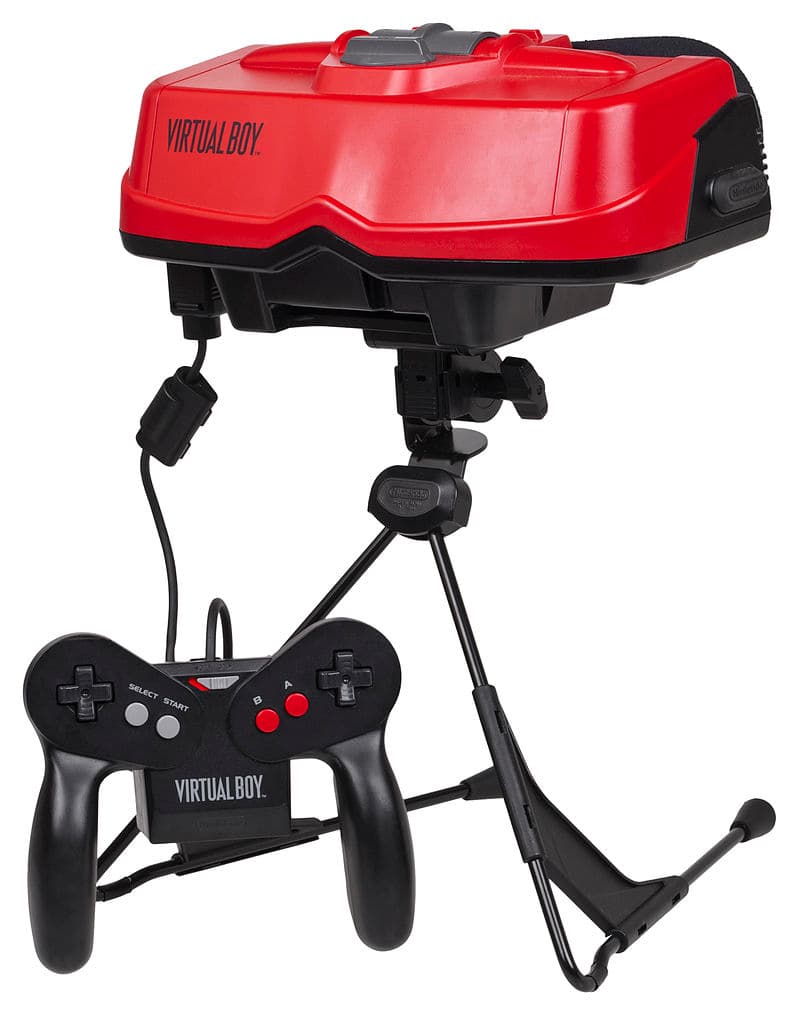
The system used a technique called parallax to create the illusion of depth. Inside the headset were two linear arrays of LEDs that projected images through oscillating mirrors, creating separate images for each eye. This created a stereoscopic 3D effect without requiring a full-color display, which would have been prohibitively expensive at the time.
Technical Specifications
- CPU: 32-bit RISC processor (NEC V810) running at 20 MHz
- Display: Dual 1x224 LED arrays producing a monochromatic red display
- Resolution: 384x224 pixels per eye
- Controls: Dual D-pads for true 3D control
- Sound: 16-bit stereo
The Launch
The Virtual Boy was released in Japan on July 21, 1995, and in North America on August 14, 1995, with a retail price of $179.99. Nintendo initially projected sales of 3 million units and 14 million games in the first year.
The launch lineup included:
- Mario's Tennis
- Teleroboxer
- Red Alarm
- Galactic Pinball
- Mario Clash
- Wario Land
The Problems
Almost immediately, the Virtual Boy faced significant challenges:
1. Physical Discomfort
The Virtual Boy couldn't be worn like modern VR headsets. Instead, it had to be placed on a table and leaned into, causing neck strain during extended play. Additionally, the red-only display caused eye strain and headaches for many users.
2. Limited Graphics
Despite the 3D capabilities, the monochromatic red display severely limited the visual appeal of games. The choice of red LEDs was made because they were the most cost-effective and energy-efficient at the time, but the resulting visuals were harsh and limited.
3. Lack of Portability
Despite being marketed as a portable system, the Virtual Boy required a flat surface and couldn't be played on the go like the Game Boy.
4. Limited Software Support
Only 22 games were ever released for the Virtual Boy (14 in North America), with many planned titles canceled as the platform struggled.
The End
By early 1996, it was clear that the Virtual Boy was a commercial failure. Nintendo slashed the price to $99 in an attempt to boost sales, but the damage was done. The console was discontinued in Japan in December 1995 and in North America in March 1996, having sold only about 770,000 units worldwide—far short of Nintendo's projections.
The failure of the Virtual Boy had profound consequences:
- It contributed to Gunpei Yokoi's departure from Nintendo after a 30-year career
- It made Nintendo cautious about 3D technology, delaying their re-entry into the field
- It became a cautionary tale in the gaming industry about rushing unrefined technology to market
Legacy and Collectibility
Today, the Virtual Boy is a sought-after collector's item, with complete systems in good condition selling for hundreds of dollars. Its unique place in gaming history as both a technical innovation and a commercial disaster has given it a cult following.
The Virtual Boy also represents an important step in the evolution of 3D gaming technology. Many of the challenges Nintendo faced with the Virtual Boy—comfort, immersion, and content—continue to be relevant in modern VR development.
While the Virtual Boy was undoubtedly a failure in commercial terms, it represents Nintendo's willingness to take risks and push the boundaries of gaming technology—a philosophy that would later lead to successes like the Wii and the Switch.