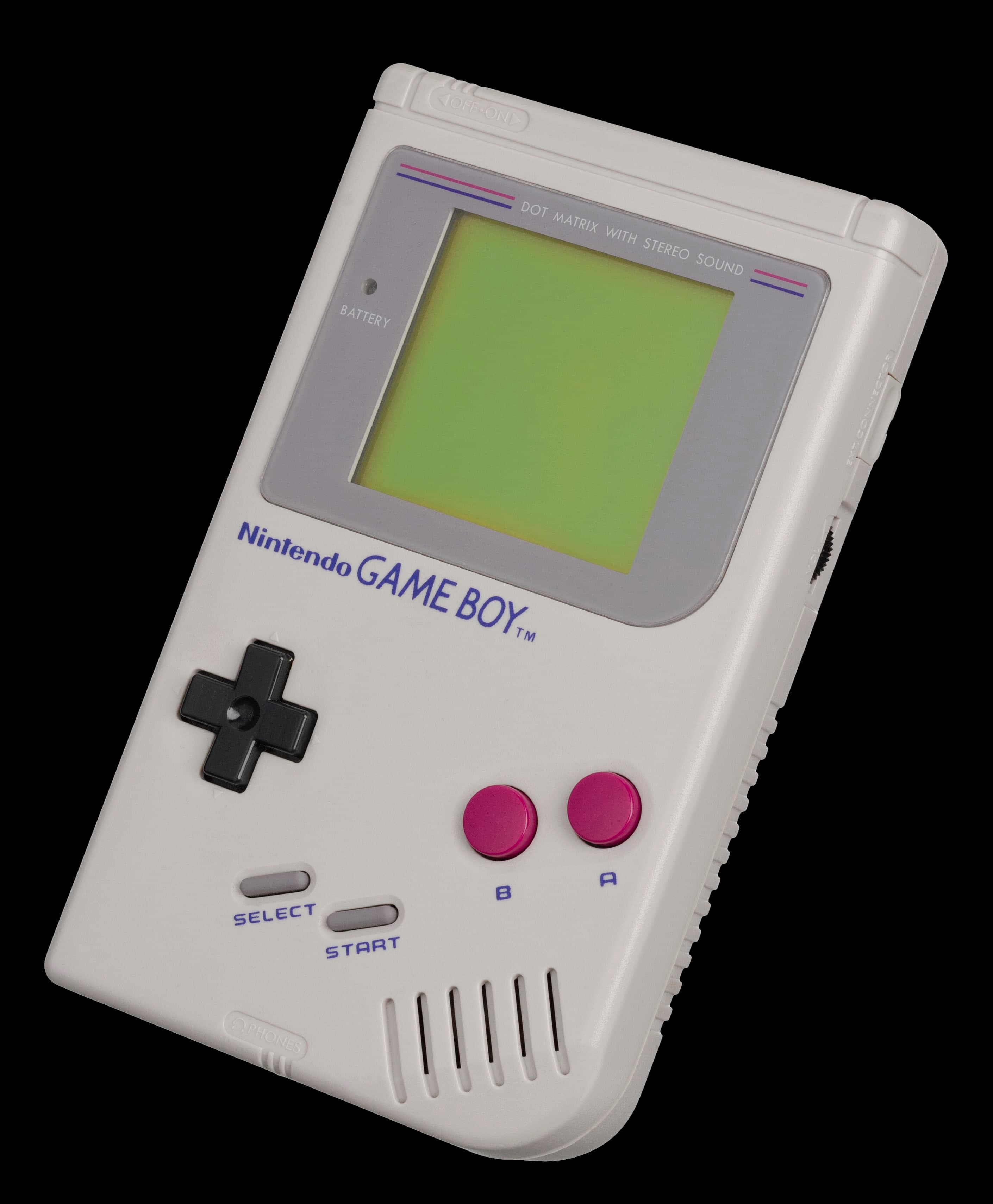
The Grey Brick That Beat Colour
In 1989 the smart money said colour would win the handheld war. Atari's Lynx had a backlit colour screen, and Sega's Game Gear would soon follow with one of its own. Nintendo answered with a grey plastic slab, a pea-green screen that couldn't show colour at all, and four AA batteries. Nintendo won, and it wasn't close.
The Game Boy launched in Japan on 21 April 1989, reached North America that July and Europe in September 1990. It came out of Nintendo's R&D1 team under Gunpei Yokoi, the engineer behind Game & Watch, whose philosophy of "lateral thinking with withered technology" meant using cheap, proven parts in clever ways rather than chasing the cutting edge.
Why the Green Screen Was the Point
The 160×144 reflective LCD shows four shades of green-grey, has no backlight and smears when things move fast. On paper it's the console's biggest weakness. In practice it's the reason the Game Boy worked. No backlight meant the batteries lasted more than ten hours, while the Game Gear chewed through six AAs in an afternoon. A screen that cheap kept the price down, too, so a Game Boy was something parents actually bought. We've made the full case in Why the Game Boy Screen Was Right About Everything.
It was tough as well. A Game Boy damaged in a bombing raid during the Gulf War still powered on and played Tetris, and Nintendo put it on display in New York.
Tetris in the Box
Outside Japan the Game Boy shipped with Tetris, and that decision did as much as any hardware choice. Tetris appealed to everyone, from kids to commuters to their parents, and the Game Link Cable turned it into a two-player battle on the school bus. Super Mario Land launched alongside it, and over the next decade the library grew past a thousand games: The Legend of Zelda: Link's Awakening, Metroid II, Kirby's Dream Land and, in 1996, Pokémon Red and Green, which gave a seven-year-old machine a second life. We've told that story in How Pokémon Red and Blue Made the Game Boy Indispensable.
Counted together with the Game Boy Color, the family sold more than 118 million units.
Buying One Today
The original model (DMG-01) is cheap, plentiful and repairable, which is exactly what a first retro handheld should be. Check three things before you buy. Look for vertical lines on the screen, usually a failing ribbon connection that a careful repair can fix. Open the battery door: light green corrosion on the contacts cleans up, but heavy rust is a warning sign. And try every button, since worn rubber membranes make the D-pad feel mushy.
Then decide how authentic you want it. A stock DMG with its unlit screen is the real 1989 experience. A backlit or IPS screen mod is far easier on the eyes, and modders sell drop-in kits and replacement shells in every colour. The bright "Play It Loud" editions from 1995 are the collector's pick if you want original hardware in something other than grey.
Either way, slot in a cartridge and flick the power switch. That "ping" still sounds like the start of something.